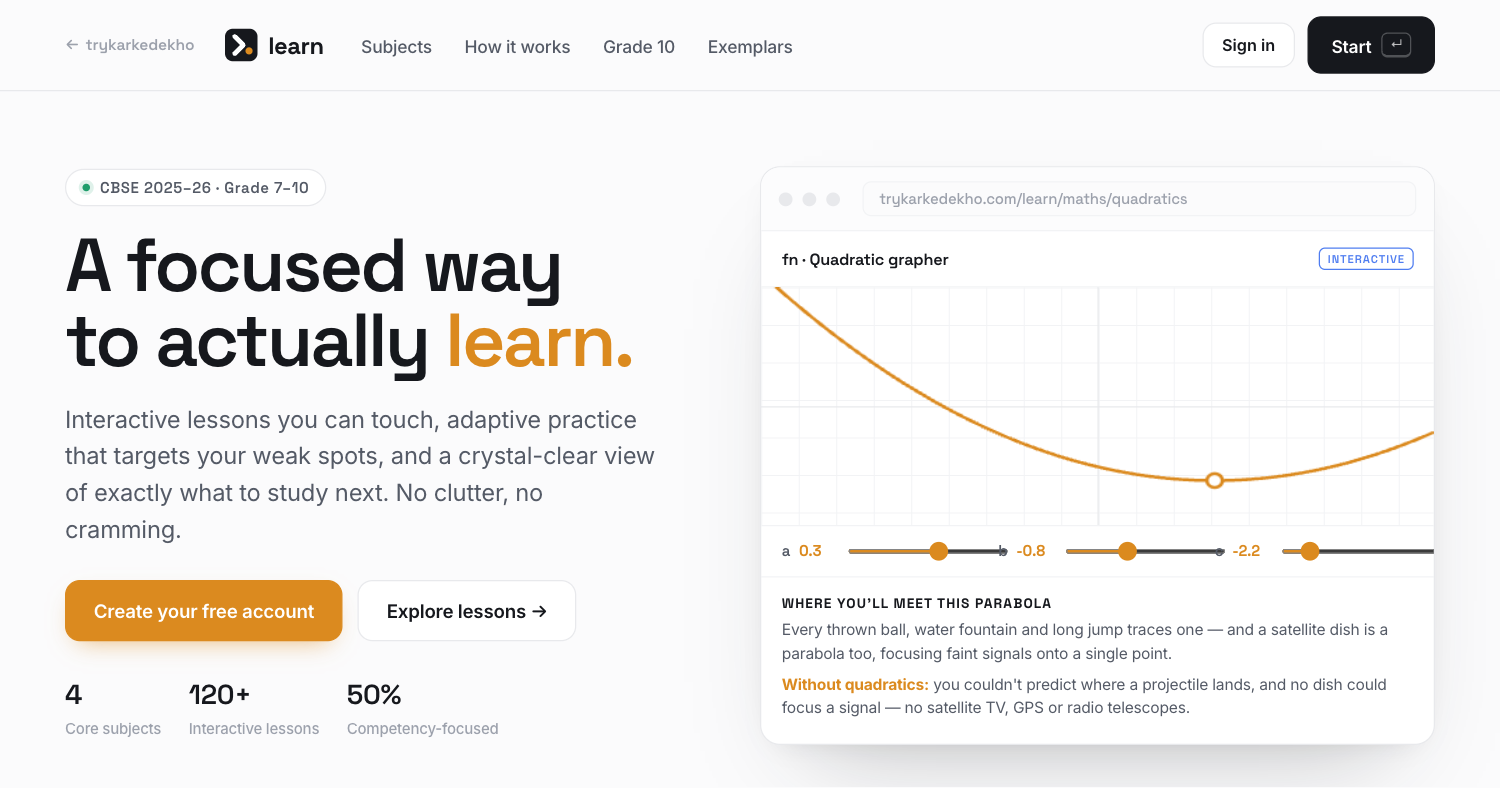
Most “online learning” for CBSE is a textbook turned into a PDF, a video of someone reading it, and a paywall in front of both. My daughter is starting Class 10. I didn’t want her — or anyone else’s kid — to learn that way. So I built the thing I wished existed, put it at trykarkedekho.com/learn, and made it free.
The name is the whole method. Try kar ke dekho — just try it and see. You don’t read your way to understanding; you do it, watch what happens, and the concept sticks. It’s the same instinct behind everything I build on the side — BrainDrop, The Data Alchemist, SYNAPTIQ, QualIQ, NumerX. This time it’s pointed at the syllabus my daughter actually has to sit.
Lessons you can touch
Open the quadratic chapter and you don’t get a wall of text — you get a parabola you can drag. Move a, b, c and the curve responds in real time; the vertex slides, the roots appear. Tilt a light ray and watch it bend at the exact angle Snell’s law predicts. Run a real reaction, charge a circuit, build a Punnett square. Every one of the 27 Grade 10 chapters — all of Science and all 14 Maths chapters — has a moment you physically play with, surfaced right at the top of the page instead of buried three clicks deep.
It matters because the maths is the same maths whether you memorise it or feel it — but only one of those survives the exam hall.
Built for how CBSE actually tests now
From the 2024–25 session, roughly half of every Class 10 board paper is competency-based: case studies, assertion–reason, application questions that ask you to use an idea, not recite it. So the quizzes drill exactly that, chapter by chapter, instead of the rote recall that papers have moved away from. And next to every interactive sits a plain-English answer to the question students never ask out loud: where will I ever use this? — with the flip side too: what simply wouldn’t exist without it. (No quadratics, no way to aim a satellite dish or predict where a ball lands.)
Buffy, the tutor who won’t make things up
There’s an AI study buddy on every page — Buffy, named after our family cat. Ask her to explain a concept, work a formula, or unstick you on a quiz, and she answers in the moment. She’s scoped tightly to the NCERT syllabus and told, firmly, not to invent things — because a tutor that bluffs is worse than no tutor. You can use her without an account; signing in just remembers your conversations and progress.
Your progress is actually yours
The hub tracks real work — XP, streak, per-subject mastery — computed from what you genuinely complete, not a demo number designed to look impressive. New here? It honestly says zero, and grows as you learn. And because Class 10 students are minors, data is handled under India’s DPDP Act: under-18 learners are gated behind verifiable parent or guardian consent, with no behavioural profiling and no ad-targeting of children. Privacy isn’t a footnote here; it’s wired into the account system.
Why it’s free
I’m not building this to make money. No fees, no ads, nothing to upsell. Registration exists for one reason — so your progress follows you and Buffy can help where you’re stuck. That’s the whole deal. I’d rather it reach a student in a town with no coaching centre than earn a rupee it didn’t need to.
What’s next
Grade 7 is coming. So are other boards — ICSE, state boards and IGCSE are next, built the same way: try first, see what happens. The plan is simple and a little stubborn: keep adding curriculum until any student who’d rather do than memorise has somewhere to go.
If you’re a Class 10 student, a parent, or a teacher — try it. Drag something. Get a quiz wrong and let Buffy explain why. Then tell me what’s missing. That’s how this gets better.
— Raja Shahnawaz Soni